

History hidden in a children’s game (Part 1)
In the far south of Santa Catarina Island, nestled between steep hills and the blue bay, twenty small children prepare a performance for their parents and grandparents. Heads and torsos appear above colorful costumes made of papier-mâché and fabric: Bento is inside a red ox; a friend inside a toucan and another inside a vulture. There's a cowboy whose body pokes through a wild horse; a goat, and the emblematic creature of the Boi de Mamão : the Bernunça. Half dragon and half alligator with an immense mouth to devour children, the Bernunça comes to life with four girls inside it. A second Bernunça is smaller, its tail is animated by the class teacher.
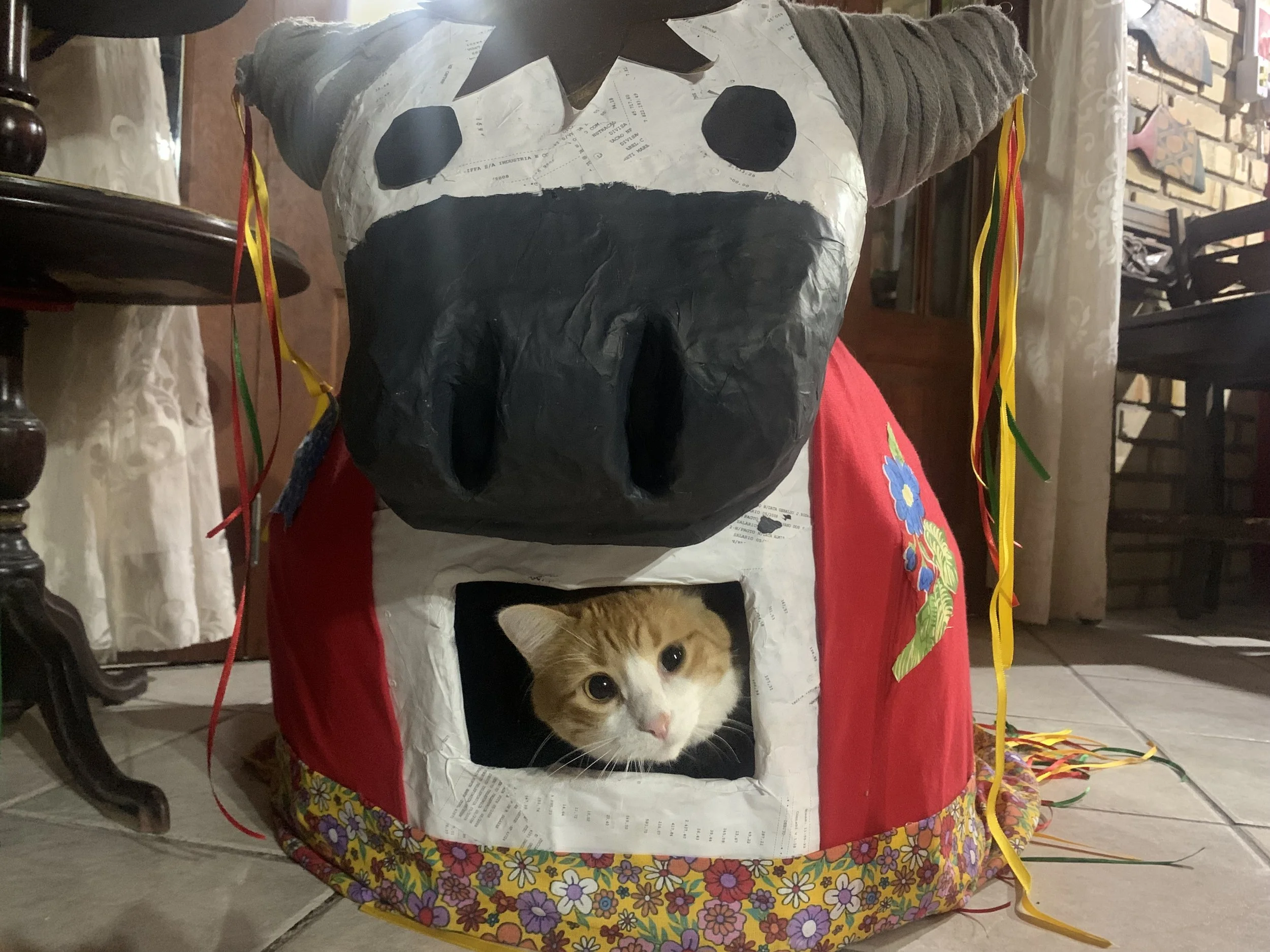
A Boi de Mamão puppet… with out cat Amora playing inside it.
The "Boi de Mamão " (Papaya Ox) is a symbol of the popular culture of the coast of Santa Catarina: it's a community game (brincadeira) that brings neighbors together during June festivals, neighborhood events, and in schools. It incorporates costumes and theater with musical narratives to become a participatory and inclusive performance. Traditionally, it is practiced by adults, but now many schools or children 's community groups perform the "Boi": the "Boi da NEIM da Caeira da Barra do Sul" is one of the first performed by little kids: these are 2-6 years old.
As the centerpiece of the school festival, the Boi de Mamão drew the attention of the entire Barra neighborhood: more than a hundred fathers, mothers, grandparents, and neighbors arrived to watch the spectacle on a Friday afternoon. Some children played their roles with the enthusiasm and comedic timing of born actors; others displayed the charming shyness of some three-year-olds. Younger siblings emerged from the audience to dance and sing with their older brothers and sisters..
And while I laughed and applauded with the children's families, I realized for the first time the power of Boi de Mamão: not only as the folklore of the island, but as a way of reliving the history of Florianópolis.
If you'll forgive me, I'm going to arrive at the Boi through another archipelago, far from the southern coast of Brazil: In the Bronze Age, many communities, cities, and cultures lived on the islands and lands around the Aegean Sea. According to some scholars, the act that brought together this great diversity of cities, transforming the various peoples of the region into a unified people called Hellas (or Greece), was a poem.
The Iliad tells the story of the war waged by the peoples who would later be called Greeks against Troy: they demanded the return of Helen to her husband, a brutal war that helped to establish machismo as the ethical code of the Western world. Much more interesting than the war itself is the story Homer tells: The Iliad is a mix of many elements, languages, myths, and stories within the same epic. In ancient Greece, each city had its cultural hero or heroine, a real or mythical figure who founded the city or gave it meaning; in the Iliad, all these figures come together to participate in the same struggle. Gods and goddesses, demigods, great warriors … all in the same poem. When a city's hero entered the epic of the Iliad, that city came to consider itself Greek. The poem serves as a pre-modern constitution, marking the participation of different groups as part of a common people.
I'm not from Santa Catarina Island; I didn't grow up with the Boi de Mamão. I came from another country as an adult, and I confess that for many years, I found the Boi de Mamão a mess, a folklore without a coherent story or narrative arc. But while applauding the kids at the Caieira pre-school with their mothers and fathers, I realized my big mistake. The Boi de Mamão is the Iliad of the southern coast of Brazil: its history, its way of bringing together the new inhabitants of the Island, marking their place, and creating a demos (a people).
The narratives of the peoples who inhabited this continent before the European invasion describe many curiosities about the invaders: their clothing, their weapons, their language … but also the horses and oxen they brought on the ships. As in many expressions of Brazilian popular culture, these oxen and horses are the figures that open the show.
The Herald — playing the role of the chorus in Greek theatre — opens the performance, presenting the ox as a playful creature that “dances, frolics, jumps, rolls and is very frisky … [ It] seems like something divine." In many versions of the Boi performance — though not in the one the kids performed that afternoon — a priest comes on stage to interrupt the Herald and condemn this phrase — “something divine” — as a divinization of nature. From its very first moments, the perforce of the Boi is trying to deal with the theological conflicts of colonization, the attempt by the church to repress the spirituality of the indigenous people and enslaved Africans, who did indeed believe that nature was “something divine.”
After the argument between the herald and the priest, the playful ox falls ill and then dies from the evil eye, and the owner sends for the doctor. The doctor is unable to cure the ox — in some versions of the script, he even accuses the owner and the cowboy of getting the ox drunk with cachaça (a type of Brazilian rum) — but then a healer arrives and resurrects the animal where the doctor could not. It is not difficult to see the conflict between popular knowledge and "scientific" and European knowledge in this passage, with the public firmly siding with the healer.
The resurrection of the ox by the healer opens the field for a narrative chaos that always bothered me in the Boi de Mamão: different animals appear — sometimes gorillas, bears, and wolves, a vulture that came to eat from the ox's carcass. The children in Caieira also made a toucan in honor of a baby toucan they cared for at school. In the Boi made at another school, the Pântano do Sul school, children invented a Preá de Moleques do Sul, a small rodent in danger of extinction — it only lives on a nearby islet where many relatives fish. Next, as with all the Boi performances, Maricota arrives — tall, blonde, with long, ungainly arms. Although the figures may be interesting or frightening and their features a true work of art, they do not seem to belong to the same story as the ox.
However, for those who read the Iliad, the experience is not unfamiliar. The confusion of characters is reminiscent of the many stories of heroes waiting on the battlefield beneath the walls of Troy. It was the new animals — toucan, preá — and the creativity of the children and their teachers that showed me that the Boi de Mamão, like Homer's poems, grows and transforms. New groups create new Bois and new ways of performing the ritual. They want to add their own history: their heroes, legends, and confusions: the toucan and the preá are just small examples of a long tradition of adding the issues that bother people at different moments of history.
Little Kids play at Boi de Mamão in the village of Caieira da Barra do Sul.