

Elections in Brazil
Last Sunday, we had elections here in Brazil. In spite of the fact that day-to-day life is better than it ever has been -- the lowest unemployment ever, reduced poverty, growing GDP, improving environmental conditions -- the far right defeated the party that had brought all of those benefits.
This week, I'm looking at how that happened. Why is the far right so strong in Brazil? The explanation takes us deep into history, into the kitchens and elevators of apartment buildings, and into how Brazilians see race.
History hidden in a toy
In the South of the island of Santa Catarina, nestled between steep hills and the blue bay, twenty small children prepared a performance for their parents and grandparents. Heads and torsos appeared above colorful costumes made of papier-mâché and fabric: Bento was inside a red ox, a friend inside a toucan and another inside a vulture. There was a cowboy whose body poked through a horse; a goat, and the emblematic creature of the Boi de Mamão: the Bernunça. Half dragon and half alligator, with an immense mouth to devour children, this Bernunça came to life with four girls inside it.
The Boi de Mamão — a ritual/game/play (brincadeira) common along the coast of the state of Santa Catarina — serves as a fascinating illustration of how play can function as memory and a power to “sustain the world.”
With clips from the movies “Um boi para as crianças”, “Coragem de Brincar o Boi,” and “Como fazer uma zarabatana”, directed by Rita Oenning da Silva and Kurt Shaw.
Learning to play — and to live — with little kids
When we look beyond the idea that the goal of the game is to win, we see that the game transforms the player; the relationship with the “opponent” transforms the player. When an escola de samba performs or during the Kuarup in Xingu, we can’t talk distinguish between the artist and the work of art or between the subject and the object she manipulates. Nor does this art really fall into the “I-Thou” dynamics so thoughtfully analyzed by mid-century Jewish thinkers like Buber and Levinas. We don’t really know if the Morena de Angola is shaking the shaker, or if the shaker is shaking her, as the classic samba lyrics insists.
With the help of little kids, toys, and farm animal, we learn how play can help us overcome the polarization of the zero sum game.
Joy is not a Scarce Resource
“When we play the drums and dance, my happiness grows together with yours,” says Ciany Castro, leader of a Tambor de Crioula. Unlike a material good — a pie, a chocolate bar, the stock of a corporation — joy is not a fixed, limited, dividable thing. The amount of happiness grows based on what activities we do, how happy you are, how happy I am, how happy a child around us is. In the realm of economic necessity, it might make sense to talk of a zero-sum game, but the moment that we talk about another immensely important aspect of human being — happiness — the fundamental premise of game theory just isn’t true. It doesn’t even make sense.
Listening to Nature
With this podcast, I’ve been trying to show that Brazilian popular culture has much to teach the world. One of the most important lessons I’ve learned from indigenous people is to sit and listen to the nature around me.
This morning, Rita and I walked into the jungle along the banks of the Lagoa de Peri, a fresh water lagoon nestled in the high mountains close to our house. It was cloudy, still, and cool — somewhere in the mid 40s Fahrenheit — and the birds decided to provide a symphony in the jungle, with only us as the human audience.
These sounds aren’t just beautiful: they are also hopeful. From the time of colonization until the middle of the last century, the jungle around Lagoa de Peri was destroyed for firewood and planting. In the last century, it has come back as exuberant and inspiring nature.
So today, in a special and unexpected episode, you can listen to the sounds of that natural symphony. Enjoy.
The Art of Play
Everything in our culture is a type of art.
A song is art for us. Dancing is art. A prayer is art. From the moment you start smoking the ritual pipe to speak with the deities, making that connection with Nhanderu—that's art.
Body painting is art. It's making a connection with Nhanderu, so it's a type of art.
Of course, there isn't a word in Guarani for "art." But everything is related to art. It's all connected to spirituality.
The Guarani people see art, spirituality, dance, and agriculture as a way of creating the beauty tat sustains and justifies the world. And all of these activities are play, a way of bringing joy into the world. If our life rotates around play instead of profit, they ask, what would it look like?
Musica is transpersonal feeling
The idea that politics is really about creating and defining enemies — and that identity only emerges from hate — is not inevitable. In this episode of Learning from Brazil, we look at how some children and indigenous thinkers show other ways to think about who I am, who you are; who we are and who they are. When we see that culture connects us in an almost physical way -- one girl described music as a sort of transpersonal synaptic connection between people -- and that more than one soul can inhabit a single body, we can think politics and culture in new ways.
And when we use these other frames for thinking, conflict and difference can be something much more productive and less threatening, a way to grow instead of something to fear.
Learning from Conflict in the Amazon and in Medellín
Conflict is inevitable. We live in a world of diverse interests, ideas, and perspectives. An unequal world, and unjust world. If you try to resolve a conflict, you’re saying that it is, somehow, false. That the situation where we live should be one of harmony and balance, if people could just see it through the one right lens. But there isn’t just one right lens!
The most important lesson we had to learn — and then to teach — is that conflict is productive. It’s good. I learn from the dispute that I have with the other person, and I grow from it: and so does he.
If you think that you should be able to resolve a conflict — I mean, make it go away, show that everyone’s interest are really the same — and yet that conflict stubbornly persists, then violence appears to be the right way to resolve it.
In the Amazon as in Medellín, part of rethinking politics comes when we understand that conflict is not bad: in fact, it’s an opportunity. For growth, for learning, for encounter.
Democracy, innovation, and the funding of civil society in Latin America
Why can funders no longer learn from organizations with innovative pathways to social change. Why are local NGOs forced tomerely implement a foundation’s strategy? In a world of increasing polarization and political hatred, this new funding strategy steals from all of us insight into how democracy could function better.
SAL director Kurt Shaw just published an article in the British Magazine Alliance: https://www.alliancemagazine.org/blog/democracy-innovation-and-the-funding-of-civil-society-in-latin-america/
Coming together: on the street, in the family, through culture
Art, ritual, and play are the most common motivations to come together in Brazil, and the drive to make beauty gives both meaning and purpose to estar juntos — being together. Think, for instance, of the immense investment of time, money, and energy required to prepare the performance of a samba school, a maracatu rural, or a Bumba-meu-boi: each one of these afro-Brazilian carnaval rituals demands huge groups of people who imagine and sew costumes, compose and rehearse new and relevant songs, and rehearse complex and difficult dances. Back rooms in homes in the favelas are filled with the cloth, feathers, and beads that dozens of women — and sometimes men — will transform into elaborate and beautiful fantasias. Sheds and barns in the sertão (backlands) become workshops where families — who may not have land or even a job — make extraordinary works of art.
Our new podcast: Learning from Brazil
Aristotle began his Politics by defining humanity as a zoon politikon (ζῷον πολιτικόν), a phrase often translated as “political animal”, but which really means something closer to “community animal” or “animal that likes to be together.” Though day-to-day living together in Brazil owes more to African and indigenous cultures than to ancient Greece, the country is truly a place where people value and seek for ways to be together. Aristotle will not be our guide through contemporary Brazil, but his idea shows that Brazilians are not alone in seeing “estar juntos” or being-together as one of the most important goals of a good life.
“The most beautiful view in the city…”
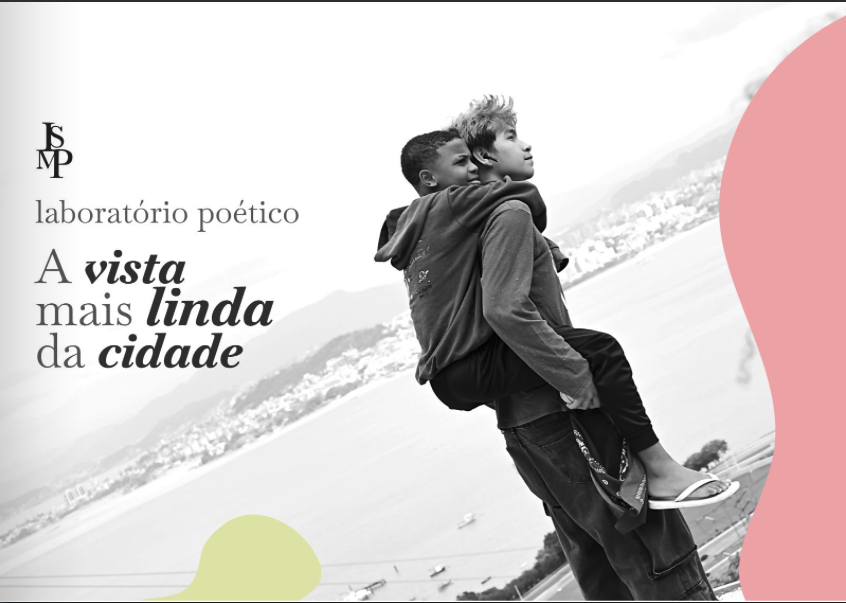
Many times, organizations and people who work fro social change emphasize the suffering of the people they serve. It can be a useful way to raise money… but it leaves out much of the life of people who live on the margins.
Shine a Light and its Brazilian partner Usina da Imaginação funded an amazing art and social change project in the favela (slum) of Mocotó in the southern Brazilian City of Florianópolis. The project used art, photography, and video so that kids from the favela could see the beauty and drama in the favele where they lived… that is has the “most beautiful view in the city.”
You can see the art the kids created at https://www.calameo.com/read/0081325228a976f400f5b
Who we are supporting: Cada Inzo um Mundo
“cada inzo, um mundo” é um projeto de formação audiovisual voltado para crianças entre 8 e 12 anos de três casas de candomblé de diferentes nações (Angola, Jeje e Ketu), localizadas na periferia do Rio de Janeiro. Ao longo de 3 meses, serão realizadas oficinas semanais com foco na escuta ancestral e nas linguagens do cinema, totalizando 12 encontros formativos. As crianças irão produzir curtas documentários sobre suas próprias casas de axé, revelando as distintas tradições religiosas, cosmologias e formas de resistência de seus terreiros. A proposta será finalizada com uma mostra comunitária de exibição dos filmes, promovendo a valorização da diversidade religiosa afro-brasileira e o combate ao racismo religioso.
Indigenous and Calon: from the coast to the backlands
This year, Shine a Light is supporting a series of initiatives to promote dialogue and encounter among groups that would otherwise be segregated by the real and imaginary walls that divide our world. One of the most interesting is an exchange between Potiguara and Calon (sometimes called gypsy) women in the state of Paraiba. Îasypytã Potiguara, who proposed it, describes the exchange this way:
“The idea of developing a cultural exchange between indigenous women and Roma women arose during a brief period I spent in a Roma community. During my stay, I was able to learn a little about their realities and notice similarities with my indigenous culture, such as the use of medicinal plants, humanized childbirth, and the production of handicrafts.
However, I also noticed that, although some knowledge is similar between the two peoples, the situation of the Roma people in Paraíba is more neglected. Even though they are very receptive and try to develop activities in their ranches, ethnic prejudice on the part of some residents of the city where they live prevents their cultural riches from being known and valued. A municipality that houses the largest Roma community in Latin America is the same municipality that values dinosaur footprints more, creatures that are already extinct.
I was driven by indignation at the devaluation of what is alive, and by witnessing the desire of Gypsy women to find work, but whose resumes are always discarded when employers read their addresses and realize their origins, that I had the idea of bringing Indigenous women to the Gypsy community to promote a day of Ancestral Experiences, geared towards female entrepreneurship. This exchange, which will be publicized and broadcast on social media, aims to draw the attention (in a cultural and peaceful way) of the authorities to the Gypsy community of Sousa - PB.
We held a day of sharing knowledge and expertise in herbal remedies and handicrafts. Indigenous women who already make a living from handicrafts and forest medicines will teach Gypsy women strategies for the production and marketing of their products. It will be the coast watering the Sertão. Women from the Atlantic Forest meeting the Caatinga. Our ultimate goal is to empower Roma women towards female entrepreneurship and build pathways that draw attention to the reality of the Roma people, aiming to break down stereotypes that affect these communities.”
Who we are supporting: Glimpses of Guarani Childhood
Olhares da Infância Guarani (Glimpses of Guarani Childhood): Aiming to strengthen Guarani culture while fostering respect for diversity and a dialogue between different forms of knowledge, this project sought to empower children and youth by placing them at the center of the narrative. It achieved this through audiovisual workshops conducted with the children and young people of the Tekoa Marangatu village (Imaruí, SC). Through sensitive listening and the use of audiovisual creation as a medium of expression, the group collectively produced a short film exploring their ways of life, play, and how they learn to relate to both their community and the natural world.
Who we are supporting: Quilombinho de Verão
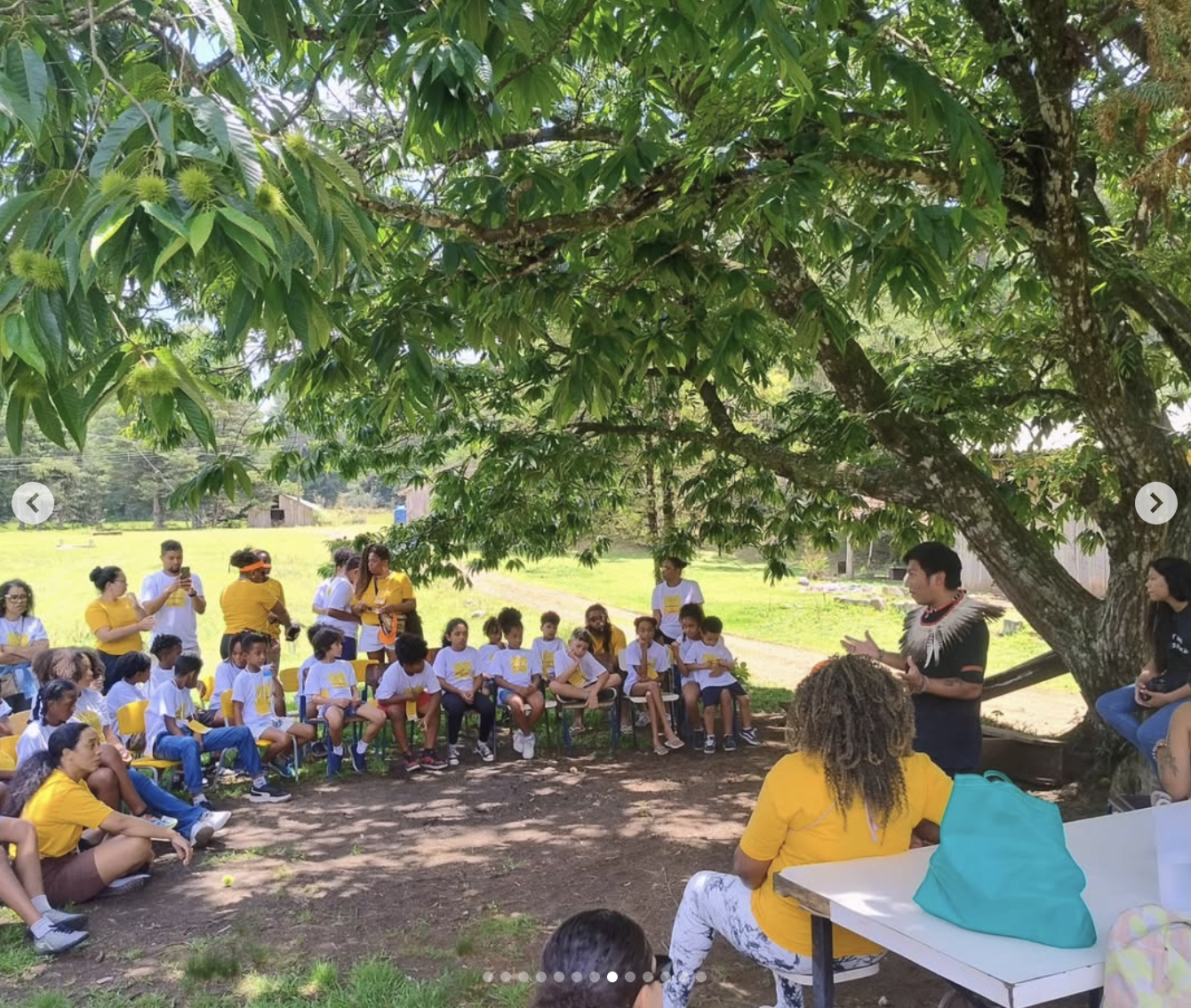
With the Brazilian NGO Usina da Imaginação, Shine a Light is supporting 10 innovative projects to promote dialogue between children and families from diverse cultures. Today, a quick look at Kilombinho de Verão, in the southern Brazilian state of Rio Grande do Sul.
The concept behind the Vivências – Kilombinho de Verão e Retomada Kaingang Kógünh Mág project was born from the urgent need to create spaces that prioritize Afro-Indigenous culture, and as a response to the lack of initiatives that value Black and Indigenous childhoods and youth through the lens of their own cultural frameworks. Our inspiration draws from Kilombos and Aldeias—territories of resistance, community, and freedom. It is through this convergence that children and adolescents will be invited to immerse themselves in ancestral experiences—experiences that respect the cycles of nature, the wisdom of elders, and the knowledge that emerges from working with one's hands and feeling with one's body. This intersection is not merely symbolic; it is historical, political, and cultural. The primary objective is to provide a transformative immersive experience within the Kaingang Kógünh Mág Retomada (reclaimed territory), located in the city of Canela, for the Kilombinho community. Subsequently—within the very space where Kilombinho takes place (the Porto Alegre Historical Archive)—we will host the Kógünh Mág community.
Initially (prior to the visits), the families participating in Kilombinho will be invited to read the book: Fàg kar segsó táhn: gufo u sí ag tú—*The Araucaria and the Blue Jay: A Story of the Ancient Kaingang*. The book presents a story that has been told among the Kaingang people since ancient times—passed down from generation to generation—whenever they gather around a campfire. The tale was recounted by Chief Maurício Salvador and translated into Portuguese by writer Ana Fonseca, who crafted the final text. The legend was published in both Kaingang (the Chief’s native tongue) and Portuguese, and features illustrations by Maureen Veras. The book was awarded the "Highly Recommended" seal by the National Foundation for Children's and Young Adult Books (FNLIJ) in the "Retelling" category, and received the Academy of Letters of Rio Grande do Sul Award for the best children's book. We have envisioned several workshops for the visits—always, however, with the utmost respect and care to ensure they are conducted with the community rather than for it. We will consult with community leaders beforehand and adapt our proposal to suit the specific context and territory, taking into account the input of those who belong to that community. Accordingly, for this initial phase of the Vivências – Kilombinho de Verão e Retomada Kaingang Kógünh Mág project, we have drafted several workshop suggestions inspired by the book Fàg kar segsó táhn: gufo u sí ag tú (*The Araucaria and the Azure Jay: A Story of the Ancient Kaingang*). These workshops focus on oral tradition, ancestry, ecology, and playfulness, and are designed to take place during the visit of the Kilombinho de Verão community to the Kaingang Kógünh Mág Retomada:
1. Listening to the Earth – A Circle with the Elders
2. The Walk of Knowledge – A Sensory Nature Trail
3. Seed Keepers – A Workshop with Pine Nuts
4. Body-Forest – A Movement and Performance Workshop
5. Weaving the Memories of the Encounter
And for the visit of the Kaingang Kógünh Mág community to the Historical Archive—joined by the Kilombinho de Verão community—we propose the following:
1. Workshop: Ancestral Araucaria – Stories That Grow with Time
2. Workshop: Flight of the Azure Jay – Guardians of the Seed
3. Workshop: Weaving Indigenous and Afro-Brazilian Stories
4. Workshop: Masks of the Forest – Creating Nature Spirits
5. Weaving the Memories of the Encounter
Through these activities, participants will experience the values of Afro-Indigenous cosmologies firsthand, internalizing—quite literally, in their own bodies—the power of collectivity, oral tradition, respect for nature, and ancestral spirituality. By the project’s conclusion, our aim is for the participating children to embrace their identities with pride, feeling a profound sense of belonging and finding their individual subjectivities nurtured and affirmed. We also aim to strengthen the bond between families, the territory, and ancestral knowledge, leaving behind—as a legacy—a replicable, community-based model of living for children and youth.
Polarization and Encounter in Brazil
Kurt Shaw’s March talk to the Colorado Foothills World Affairs Council.
Talk at the Colorado Foothills World Affairs Council
Tomorrow — Wednesday, March 11 — Shine a Light Executive Director Kurt Shaw will be speaking at the Mount Vernon Canyon Club at 24933 Club House Drive, Golden, CO, at 7PM. The speech to the CFWAC is free and open to the public.

Long known for an ethic of hospitality and the virtue of the “cordial man,” Brazil has come to rival the United States for the fury and animus of its political polarization. How has Brazilian public opinion — so hopeful and unified only a decade and a half ago, turned to the rage and division one sees in a variety of political movements?
The conversation on polarization concludes with the seeds of hope, showing how afro-Brazilian and indigenous ideas of conflict as productive can offer a pathway to dialogue, and how traditions of making art together — in carnaval, in samba, music, and sport — may provide new opportunities for overcoming polarization.
Kurt Shaw studied philosophy at Williams and classics at Harvard, but his real education came from two years in Central American refugee camps and Colombian slums, where he found poor and marginalized people more compelling thinkers than many academic philosophers.
He developed the world’s largest network of grass-roots organizations serving street kids, work that contributed to the dramatic reduction in the number of children living on the streets of Latin American cities. Seeing the power of collaborative film-making with children, Shaw and co-director Rita da Silva directed the first feature film made entirely by ex-child soldiers, produced an indigenous telenovela in Bolivia, and directed the first fictional film in the Amazonian Tukano language. Their The Princess in the Alleyway, won best film of 2017 by the Subversive Cinema Society and their 2019 documentary The Other Side of the Other spent two years on rotation on Brazilian public TV.
Shaw has published many academic and journalistic articles, two novels, and seven academic books on topics ranging from political philosophy to Amazonian epidemiology, as well as producing hip-hop and pop albums. He has won a Fulbright, the Harvard First Decade Award, The Freedom to Create Prize, and the United Nations Intercultural Innovation Award. In 2022, he was awarded an Academic Visitorship at Oxford University. Over the last decade, his research has examined the roots of Brazilian political polarization in the history of Portuguese colonization, slavery, and Brazil’s complicated relationship with race, wealth, and culture, based on hundreds of interviews and dozens of films with Brazilians from all walks of life.
History hidden in a children’s game (Part 3)
A few weeks before the Children's Boi in Caieira, I participated in a workshop where Silvana Mindua, a Guarani teacher, taught a group of children and teenagers how to make a blowgun.
You kids shouldn’t forget that all toys were once a work of art or were once made to use. This blowgun, a bow and arrow: when you play with them you act out a story that comes from a long time ago. What does this zarabatana mean? For us, it was once life, our survival.
In the old days, our ancestors made blowguns for practical use. But of course kids used it as a toy: that’s what kids do. They observe and learn. Older children made blowguns and then the little ones watched; they made play zarabatanas that were also real ones.
We no longer have open land where we can hunt, but we can still hold onto the meaning of these crafts and toys: basketry, the blowgun, bow and arrow. Our traditions have become indigenous art. Indigenous toys.
For those who prefer a more European theorist, Walter Benjamin wrote something similar a hundred years ago:
Frequently, so-called folk art is merely the residue of cultural goods that renew themselves when assimilated into a wider community … it is precisely through these rhythms [of play] that we first become masters of ourselves. ( Walter Benjamin, Reflections on the Child, Play, and Education. SP: Editora 34, 2002. pp 100-101 )
In a way, what I'm suggesting here is that the Boi de Mamão is a blowgun. Colonization robbed the Guarani of their hunting grounds, but the toy survives as a way to maintain their culture and memory. The church repressed Judaism and continued to persecute the New Christians, but they hid their culture in a game or ritual they would call the Boi de Mamão. Hegemonic western medicine stripped the witches, healers, and Afro-Brazilian curandeirosof their authority, but something of that past remains alive and hidden in the Boi.
During a performance of the Boi at the Pântano do Sul school, a woman told me how she and her friends played Boi when they were children. At that time, the men of the community still practices the Farra do Boi — a traditional bullfight that was later outlawed — and in June, the children would dig up the bull's skull, put it in an anthill to clean it, and use the skull as the head of the Boi de Mamão. This childhood practice transformed the " thing " — the frightening bull whose meat was essential for the community's survival — into a toy. The bull sacrificed in the Farra is resurrected in the toy for the Boi de Mamão, just as Mateus's bull is resurrected by the healer in the performance
Some interpreters say that the torture of the bull in the Farra represents the punishments of Judas — a representative of the Jews in many forms of Catholicism. Interviews from when the Farra was legal indicate that the men who carried out the Farra described their activity as "jewing" the bull — a common word in colloquial Portuguese, but powerful in this context.
In rabbinic tradition, the great ritual of sacrificing oxen takes place during the week of Sukkot: like Saint John 's Day in Brazil, Sukkot is the harvest festival. Before the destruction of the Temple in Jerusalem, the priests slaughtered 70 oxen on Sukkot, and their meat provided the food for the festival's barbecues.
“The Talmud observed that the number of bulls totaled 70, or the equivalent, in rabbinic language, to the number of Gentile nations on Earth. For the rabbis, henceforth, the profusion of bulls constituted a fervent prayer on behalf of the non- Jewish world… The bulls served to atone for the misconduct of the Gentiles… this ritual was elaborated not for the conversion of the Gentiles, but for their well-being. ” ( https://www.jtsa.edu/torah/the-seventy-bulls-of-sukkot/ )
The sacrifice of the 70 oxen is the ritual that guarantees the survival of the world. For the Guarani — traditional inhabitants of the coast where the Boi de Mamão is now practiced — prayer, dance, and song also guarantee the survival of the cosmos (or, in the elegant words of Airton Krenak, “postpone the end of the world ” ).
I don't want to insist that the Boi de Mamão is a syncretism between Judaism and Guarani spirituality — although I do want to present that possibility. What I want to claim in this playful text is that play in its many forms can be a way of remembering and reliving the past. In script of the the Boi de Mamão, the healer resurrects the ox. In the Boi de Mamão of Pântano do Sul, the children's play "resurrected " the skull of the ox killed in the Farra as a toy. The performance of the Boi de Mamão both gives a symbolic continuity to Sephardic Judaism and represents the great Guarani insight that play is a remnant of the past and the way to hold off the end of the world.
My unease with the Boi de Mamão when I first came to Santa Catarina, the feeling that it lacked coherence and narrative arc, only shows that I didn't understand what I was watching. I thought the Boi was a spectacle. The Boi is not a theatrical work, nor a dance, nor a musical show. It's a game — which means it's ritual, history, resurrection, and joy.
History Hidden in a children’s game (part 2)
Another example of this incorporation of local memories and concerns into the Boi, is that the healer cures the ox with the help of Saint Benedict. One of the few Black saints in Catholic iconography — and an important symbol of Afro-Brazilian cults in other regions of Brazil, such as the Tambor de Criola — I can imagine this inclusion as a way of dealing with the spiritual power and medicine of healers from the African diaspora. The most talented doctor of the South of the Island of Santa Catarina at the end of the 19th century, for example, was Batuel Cunha, who practiced at the foot of Morro do Lampião. He acquired a large plot of land there as a reward for his success as a doctor, something uncommon for Black people at that time.
Maricota exhibits the same phenomenon. After the departure of various animals from the zoo, a dancer arrives on stage, dressed as a large blonde doll. His swirling steps throw his long arms all over the hall. This character emerged from encounters with German women: blonde, tall, and lacking the graceful movement of the local women, they confused the traditional inhabitants. A traditional Maricota song illustrates this association with German food: “ She is big, a big woman; She eats rice and beans; But what does she eat to become so tall? Cabbage and potatoes.” Cabbage and potatoes are the classic foods associated with Germans in the south of Brazil: they inscribed their confusion with this new diet into the story they told in the Boi de Mamão.
But it is Bernunça, the symbol of the Boi de Mamão, that most clearly shows how this popular ritual both conceals and reveals the history of the Island. To analyze this, we have to go back to the Azoreans who came to populate the coast of Santa Catarina.
With the Spanish Inquisition, many Jews and New Christians — involuntary converts to Catholicism — fled Spain for Portugal. A generation or two later, with the arrival of the Inquisition in Lisbon, they fled again, this time to Morocco, Istanbul, Holland, Pernambuco … and the Azores. Not all the inhabitants of the Azores were Jewish or New Christians in the 18th century, but a strong Jewish tradition persisted. Synagogues, schools, and rabbis practiced somewhat secretly, but there was more religious freedom than in the urban centers of the empire. Staring in the 1750s, the Portuguese crown sent this mixed population to colonize the coast of Santa Catarina.
In interviews with various experts of the Boi tradition, they explained to me that the “Bernunça” is a mispronunciation of “renunciation.” A poem by Claudio Santoro makes the same argument.
The cry of the Bernunça baptizes,
announces.
It opens the way, opens
its mouth, tears
everything from its place,
swallows gulp by gulp,
and returns in a single blow not
what it had swallowed,
but something new,
the
fruit of renunciation.
Abrenuntio Dominum.
But what is the connection between “renunciation” and this monster in a folkloric ritual? Something that frightens and swallows?
All the children on the island know the song of Bernunça :
Olé, olé, alé olé olá,
Get out of the way, the bernunça wants to pass.
I was working when I heard about the war.
But it was only the bernunça that was coming down the mountain.
Bernunça is a fierce animal, it swallowed Mané João;
It eat bread, it eats biscuits, it eats everything they give you."
Renunciation defines the new Christian: renouncing Judaism and affirming oneself as a Roman Catholic is what opens access to the assets of the Portuguese state and its colony in Santa Catarina. The bread and biscuits eaten by the bernuça may also point to the host, the small wafer New Christians would be forced to eat to prove they were not backsliding into Judaism.
At the narrative climax of the traditional Bois de Mamão, the Bernunça, animated by several men, moves its immense mouth and pulls children from the audience inside itself. The monster swallows, incorporates. In some variations of the Boi, the Bernunça regurgitates the child; in others, the Bernunça gives birth to a little Bernunça — a new puppet where the swallowed child becomes an improvised actor. This experience inspires fear in many children — my daughter was terrified of the Bernunça — a fear that reflects the true fear of the Jews devoured by an enemy belief … and then transformed into it.
This is exactly what Bernuça represents: it literally devours Jewish children and transforms them into almost unrecognizable little Christians..
Different versions of the script used by different Bois give even more evidence that the renunciation of Judaism founds this ritual. For example, many versions play with the name Matthew, the owner of the ox. After the Herald declares that the ox "seems like something divine," the priest accuses Matthew of atheism.
The Priest [ interfering furiously ]
Wait a minute, wait a minute, wait a minute. This is sacrilege ! To say that Is an ox divine? Are you crazy? Who owns that ox? You atheist, you atheist, you atheist !
Matthew
My name is Matthew, Your Excellency, and I am not an atheist. It 's Matthew, like the name of the holy apostle.
Here we hear the echo of the legal defenses of the new Christian, accused by the Inquisition. “I’d as good a Christianas the apostles!”
When the healer performs the magic to resurrect the ox, we understand even more the Jewish basis of the Boi:
Healer
By the symbol of Solomon
Audience
By the symbol of Solomon
Healer
I bless you with the blessed candle on Passover Friday.
Audience
I bless you with the blessed candle on Passover Friday.
Healer
The sun has thirteen rays.
The moon has thirteen rays.
Jump demon to hell
For this soul is not yours.
The “Symbol of Solomon” is the Star of David within a circle; it is a symbol of Kabbalah, the system of magic and mysticism of the Sephardic Jews of the Iberian Peninsula. The “blessed candle" has an important role in Catholicism, but a candle lit on Friday is a Jewish practice, since after sunset on Friday becauseone cannot light a candle on Shabbat — and even more the Passover Candle. And finally, thirteen — “thirteen rays of the sun … thirteen rays of the moon” — is an ominous number in Christianity, but a divine number in Kabbalah, where it represents the number of gifts God bestowed upon the people of Israel.